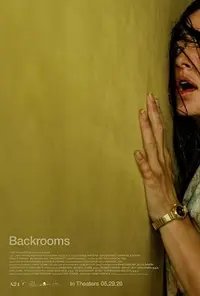
Why Backrooms feels uncanny: space, repetition and the loss of a usable map
A familiar interior becomes frightening when it stops helping us navigate. This guide connects the official premise and Kane Parsons’ set-design comments with a practical way to read spatial horror.
The familiar place stops being useful
A24’s premise begins with a doorway in a furniture showroom basement that opens onto an apparently endless network of connected rooms. The crucial disturbance is not simply that the rooms look unpleasant. An ordinary commercial interior promises a comprehensible purpose and a way back. The doorway changes what that promise is worth.
Our reading of this kind of horror starts with the gap between recognition and use. You can recognise a corridor without knowing where it leads. You can identify the shape of an exit without being able to establish that it reaches an outside. A place can retain familiar visual language while withdrawing the practical information that usually makes that language reassuring.
Repetition can destroy confidence in a route
A repeated feature normally helps orientation: a desk, sign or distinctive doorway lets us recognise where we have been. When too many spaces resemble one another, the same mechanism works against us. Recognition no longer distinguishes progress from a return to somewhere we already passed.
For a scene-level analysis, separate two possibilities. A continuous shot may establish a route that becomes impossible, while an edit may simply omit the connection between two places. The first gives stronger evidence of a spatial contradiction. The second can create uncertainty without proving that the fictional building has changed. Confusing them turns an effect of presentation into an unsupported rule about the world.
Designing confusion is different from filming randomly
In the A24 conversation with James Wan, Parsons describes designing sets in Blender, using that work to plan shots and collaborating with the physical production. He also discusses the substantial area of rooms constructed for the film. Those comments establish a deliberate design process; they do not by themselves reveal a complete map of the story’s space.
That distinction suggests a useful viewing question: what does the frame let the character know, and what does it let us know? A shot can make the layout clear while leaving the destination unknown. Another can conceal the route itself. Both produce suspense, but they produce different kinds of uncertainty. The craft lies partly in controlling which information is missing.
Sound can offer a route that the image cannot confirm
Sound has a special role in spatial horror because it can point beyond the visible room. A viewer can hear an apparent source before discovering whether the route toward it exists. Treat this as an analytical method, rather than a claim that every sound in Backrooms has a secret meaning.
When a sound changes, ask whether the character reacts before the camera supplies new information. Then consider whether a later shot confirms the source or merely encourages us to imagine one. An explanation that accounts for that order is more precise than calling the entire soundtrack unsettling. Silence can be equally significant when it removes a cue we had started to rely on.
Why more lore is not always a better explanation
A catalogue of named levels or creatures can be enjoyable fan interpretation, but it should not be imported as established rules merely because a film shares the Backrooms name. The official premise and a filmmaker interview support specific statements about this production. A theory assembled from other works needs its own evidence of continuity.
Spatial dread can also operate before a monster or mechanism has been explained. If the anxiety comes from an environment ceasing to answer ordinary questions, a fully labelled map may describe away the very experience being analysed. That is an argument about how the premise works, not a reason to dismiss viewers who prefer clearer narrative answers.
A useful way to discuss one sequence
Pick a transition and record what you knew immediately before and after it: the route, destination, sound source and character’s available choices. Identify which piece of information disappears first. Someone else can then test your interpretation against the same transition.
A productive disagreement might be whether the sequence makes the space impossible or simply makes our access to it incomplete. Both readings address a concrete formal choice. This guide leaves the film’s final explanation open and offers a method for describing its unease without pretending that every repeated room proves the same theory.