
Birdman’s ending: Sam’s look is firmer evidence than a literal rule of flight
The final window scene shifts perspective after a performance that has already confused recognition and escape. A reading of what is shown, what is inferred and why certainty remains limited.
FilmFanatics Editorial · Published · View discussions
The ending gives a response without a complete external account
The final window sequence shifts attention to Sam's look rather than showing every step of Riggan's action from an independent viewpoint. Her response provides an expressive direction, but it does not function as a complete mechanical explanation of flight or escape.
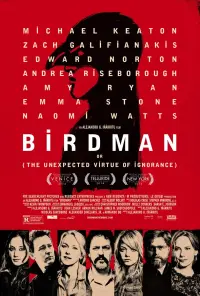
Our reading is that the film preserves the tension between a desired transformation and the problem of verifying it. A literal interpretation is available to discuss, but it should account for the film's earlier unstable relation between fantasy, performance and observation.
Sources: 1
Guide · Sources checked
Public recognition has already become an ambiguous reward
The theatre event produces attention through an action whose artistic and personal meanings are difficult to separate. Being noticed does not necessarily provide the secure identity Riggan wants. The response can reward an event while leaving the person who performed it uncertain.
That context matters at the window. A simple account in which applause solves the crisis would have less reason to move into another unresolved image. The final scene asks what kind of escape recognition has actually made possible.
Sam’s perspective is part of the form
A look can establish what a character attends to without making the audience see precisely the same object. The sequence invites us to connect her changing expression with a possibility. The connection has force even when it stops short of an objective diagram.
An expressive reading can understand the image as release from a dominating identity. A more literal reading can draw on the film's repeated supernatural imagery. Neither should ignore the absence of a complete confirming view in this final moment.
Ambiguity is not an invitation to abandon evidence
Choose an earlier scene and identify how its viewpoint works. Does the film later revise it, contradict it or leave it unverified? That pattern offers a better basis for interpreting the ending than selecting whichever future would be most satisfying.
The related discussion asks what Sam's look establishes. Separate the observable response from the event you infer. That gives different readings a shared point of comparison and keeps the ending connected to the film's larger problem of being seen.
Sources
Discussions
New threadWhat does Sam’s final look establish in Birdman, and what do we supply?Spoilers
0 repliesLast post