
Whiplash ending explained: Andrew takes control, but of what?
The final performance gives Andrew agency inside Fletcher’s musical world. That is why the ending can feel triumphant and disturbing at the same time.
FilmFanatics Editorial · Published · Updated · View discussions
The short answer: musical control is not the same as freedom
Andrew takes command of the final performance after Fletcher attempts to humiliate him. He returns, begins his own direction for the music and makes the conductor react. The scene therefore gives him a genuine achievement. It does not show that he has escaped the belief that musical greatness justifies every personal cost.
Our reading is that both effects matter. Calling the ending only a defeat overlooks Andrew's initiative and skill. Calling it an uncomplicated victory overlooks the relationship and narrowed future through which the film has taught us to understand that skill.
Sources: 1
About Whiplash (2014)
Log in to save this articleExplore music & screen coverageHow we source and review our coverageGuide · Sources checked
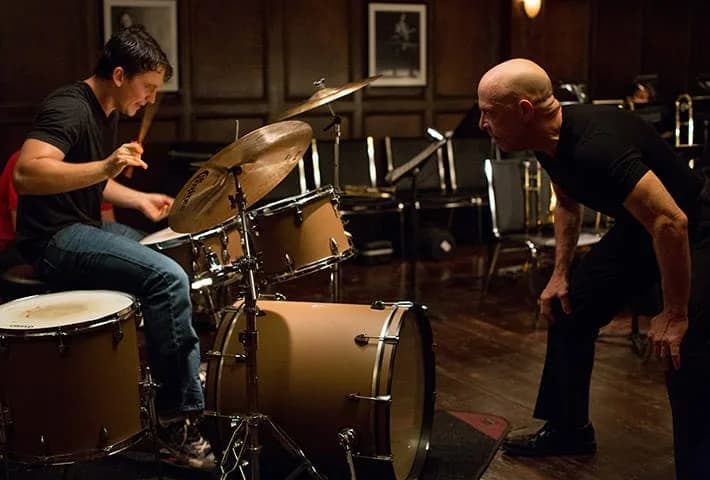
The reversal happens inside an existing system
Fletcher loses immediate control of the stage, then becomes involved in helping the performance reach its conclusion. The change can look like recognition between equals. Yet recognition from this particular person has been a central object of Andrew's pursuit, so receiving it can also bind him more closely to the same terms.
The father's position gives that exchange another frame. He witnesses something extraordinary while remaining outside the intense understanding forming between drummer and conductor. The film does not require a speech to make the distance legible.
Why the final exchange supports competing reactions
The ending allows viewers to feel the force of a performance rather than merely hear a character call it great. That emotional experience is evidence for the triumphant reading. It is not proof that Fletcher's earlier cruelty was necessary, or that every consequence of Andrew's pursuit has been repaired.
The alternative reading is therefore not that the music fails. It is that success can complete a damaging pattern. Acknowledging the excellence makes that possibility more troubling, not less.
Reconstruct the final concert before judging its result
Fletcher's concert invitation initially looks like a way back into the musical world Andrew has lost. On stage, the prepared relationship collapses: Andrew is confronted with music he cannot play as expected, and Fletcher makes the humiliation personal. Andrew leaves before choosing to return and begin a different piece. That order matters. His later command of the performance is an answer to an attempted defeat, rather than evidence that the invitation was secretly benevolent.
Once Andrew initiates the change, Fletcher cannot simply conduct the program as planned. The other musicians must respond to an intervention whose consequences are happening in front of an audience. Andrew's initiative is therefore real and risky. A reading that treats him only as a passive victim misses the decision that changes the scene's immediate direction.
Does the music justify Fletcher's methods?
The film makes a powerful performance available for the audience to experience. It does not provide a controlled comparison showing that the same achievement could only have followed humiliation and abuse. The difference is important: a result can be extraordinary without proving that every action leading toward it was necessary or right. Fletcher's own account of how greatness is made remains a character's justification.
One way to test the triumphant interpretation is to ask what Andrew now controls. He controls important musical decisions within the scene. He does not demonstrate a new ability to keep friendships, family or physical well-being outside the demands of performance. The cut leaves that larger question unresolved, so claiming that his entire life has been repaired would extend beyond the evidence.
Why the father's reaction changes the scale of the scene
Andrew's father sees his son achieve something that is difficult to dismiss. Yet he watches from outside the intimate exchange developing between Andrew and Fletcher. That position lets the film hold two responses together: recognition of the musical event and apprehension about the relationship through which it is being understood. His presence brings an earlier account of Andrew's life into a room increasingly organized by another person's standards.
This does not require assigning a single precise thought to the father. His location and reaction are enough to complicate the exclusive focus on drummer and conductor. When discussing the scene, describe what the film shows before supplying an interior monologue it never gives him. The gap between witnessed achievement and feared cost is already dramatic.
A counterreading: recognition between musicians
The most persuasive optimistic reading is that Andrew stops performing only to obtain approval and begins imposing a musical idea Fletcher must acknowledge. The conductor's response can then be understood as professional recognition rather than complete psychological possession. That reading accounts for the pleasure and momentum of the scene instead of assuming the audience has been mistaken to feel them.
Its limitation is what happens after the immediate reversal. Fletcher participates in shaping the performance's conclusion, and their shared understanding again becomes central. The film ends before showing whether Andrew can carry his initiative into a less damaging relationship with work. Both readings can use the same exchange; they differ over how much of Andrew's future the exchange is allowed to settle.
Questions for a rewatch
Watch the transitions between leaving, returning and taking the lead. At which point does Andrew make a decision whose purpose you can identify without relying on Fletcher's explanation? Then compare the camera's attention to the performers with its brief access to the people outside their exchange. The scene's emotional movement depends on that distribution of attention as well as the solo itself.
A useful discussion question is whether victory here means defeating a person, producing a performance or changing a system of values. Those are different claims and require different evidence. Name the claim you are making, identify the moment that supports it and acknowledge the question the final cut leaves unanswered. That creates a stronger conversation than labeling the ending simply happy or unhappy.
What the film leaves beyond the cut
We do not see Andrew's complete career, his later relationships or a retrospective judgment proving one future inevitable. Avoid turning a possible trajectory into a scene the film never shows. The ending resolves a performance while leaving the life built around it unsettled.
For discussion, identify the exact moment when you think control changes hands. Then ask whether the terms of the exchange change too. That keeps the argument grounded in the sequence rather than making artistic achievement and ethical judgment into interchangeable questions.
Sources
Discussions
New threadDoes Andrew defeat Fletcher at the end of Whiplash, or complete Fletcher’s project?Spoilers
0 repliesLast post