
Jumanji: Open World takes the game out of the console at Christmas
Sony’s final installment in the current trilogy brings its familiar team into a world where the game can reach them.
News analysis · Sources checked
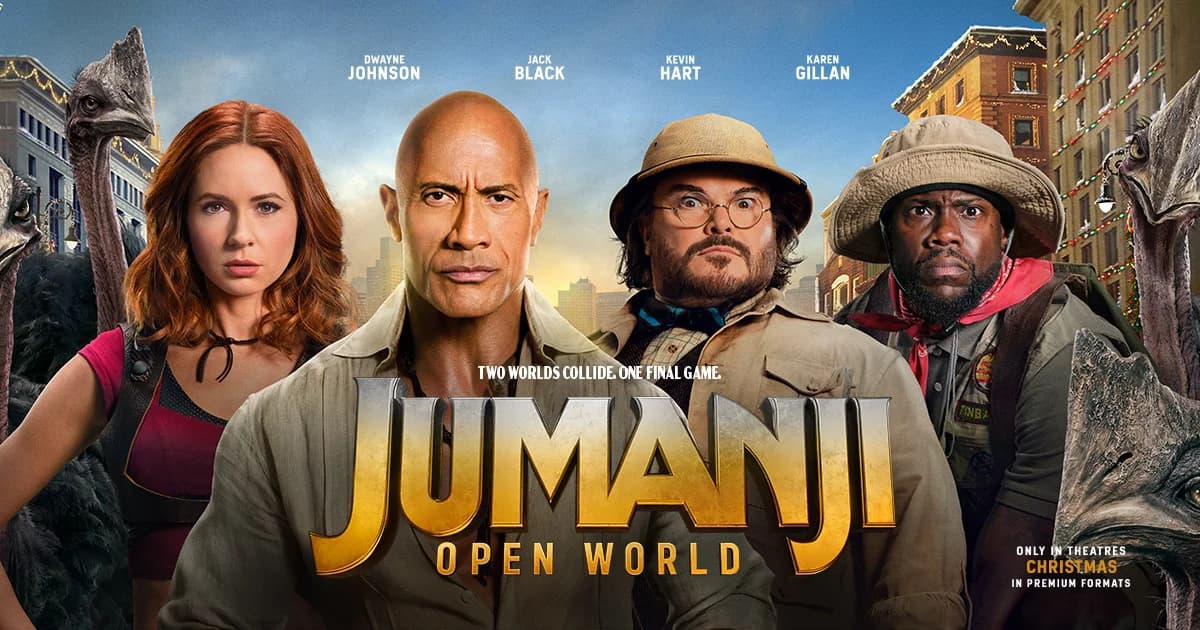
Sony identifies Jumanji: Open World as the final installment of the current adventure trilogy and dates the U.S. release for December 25. Jake Kasdan directs. Dwayne Johnson, Jack Black, Kevin Hart and Karen Gillan return as the game’s rules spill into the world outside it.
The location switch gives the series a reason to change its rules
Inside a game, a landscape can signal that every object belongs to a challenge. A school hallway or supermarket begins with conventions the audience already understands. A familiar place becoming a level can be funny before the characters have figured out what just changed.
The returning actors are the other part of that equation. Their performances are at their best when the audience can distinguish how a character thinks from how their avatar looks. Reuniting the team outside the console is a chance to make that difference matter again.
An ordinary location needs consequences beyond a visual joke
A game rule appearing in a familiar place can produce an immediate comic image. To sustain a sequence, it must also alter what the characters can safely assume. A route that normally takes seconds might become conditional; an everyday object might acquire a function that only one person understands. These hypothetical examples illustrate the premise’s possibilities, rather than describe scenes confirmed by the announcement.
The important issue is consistency. Once a rule has changed, the audience needs enough information to anticipate a consequence. A surprise can then come from a clever use of that rule instead of a new exception introduced at the last moment. That gives viewers a way to participate mentally in the action while still enjoying its absurdity.
A final installment needs to end a relationship as well as a game
Sony calls this the final entry in the current adventure trilogy. That description creates an expectation of closure, but closure need not mean accounting for every piece of mythology. It can mean resolving a way the group works together: who trusts whom, who takes responsibility and what a person can now do without the protection of an avatar.
The return to the ordinary world makes that distinction especially relevant. A lesson that works only inside a game has a different weight from one that changes behavior outside it. The most useful post-release comparison would identify how a familiar performance pattern changes when the setting changes. The official synopsis confirms the returning quartet and the premise; it does not establish which particular character will carry the ending or whether any rumored appearance is real.
Sources
Discussions
New threadNo discussions yet.