
The Sopranos ending explained: the diner, the cut to black and the limits of the death theory
The last scene establishes a pattern of looking, then refuses its expected answer. Follow the diner sequence and compare what supports Tony’s death with what the episode actually shows.
The short answer: a missing image is the ending’s central event
The Sopranos does not show Tony being shot in the diner. It cuts to black before the next expected view, ending the scene and its sound. The death interpretation is powerful because of the way the sequence organises attention and because violence can arrive without warning in Tony’s world. It is still an interpretation of an interruption, rather than an event visibly completed on screen.
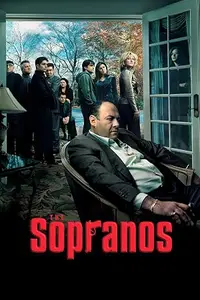
That distinction does not make the ending meaningless or every theory equally persuasive. Our reading is that the scene lets a family reunion and an approaching threat occupy the same ordinary space. Whether the interruption represents Tony’s death or the permanent uncertainty of his life, the audience loses the secure position from which it could watch him continue.
How the diner teaches us to expect another view
As people arrive, Tony looks toward the entrance and the editing connects his attention with what is entering the room. The bell is not a supernatural code. It is an ordinary sound that becomes a cue for a repeated act of looking. Repetition gives the last interruption a shape: we have learned to anticipate a continuation that does not arrive.
Meadow’s parking delays her entry and extends the sequence outside the booth. Meanwhile, a man’s movement toward the restroom gives a viewer something potentially threatening to track. Neither action proves a murder. Together they divide attention between routine family business and the possibility that a routine gesture is about to become something else.
| What is shown | Why it matters | What it does not prove |
|---|---|---|
| Tony repeatedly looks toward arrivals | Builds an expectation about the next shot | That every shot is literally his vision |
| Meadow is delayed outside | Postpones the completed family gathering | Who would attack Tony |
| A man goes toward the restroom | Creates a plausible direction for danger | That he is a confirmed assassin |
| Image and sound stop | Breaks the established continuation | A visible death or a visible escape |
The strongest case for the death reading
The strongest version of the theory starts with form, not a hunt for arbitrary background numbers. A look appears to call for a corresponding view; instead the audience receives nothing. Earlier conversations about how death might be experienced make that nothingness especially disturbing. The viewer can connect a missing continuation with the disappearance of the person whose attention has helped structure the scene.
This is a case built from relationships between moments. It becomes weaker when every prop, extra or wardrobe colour must function as proof. An interpretation does not improve merely by accumulating details that could be made to fit it. Ask which feature would be difficult to explain if the scene were only showing another anxious dinner, and which would remain ordinary under either reading.
The strongest alternative: life continues without safety
An alternative reading emphasises the danger of continuing rather than the certainty of dying at that second. Tony has survived immediate conflicts, but survival has not removed the conditions that make a diner door worth watching. The family can share food and recall better moments while a viewer remains unable to settle into uncomplicated reassurance.
The limit of this reading is that it must account for the specific abruptness of the cut. Saying that life is uncertain is too general on its own. A stronger argument explains why the episode trains an expectation and withdraws it at precisely this point. It can treat that withdrawal as the end of our access to Tony without insisting that the story demonstrates his continued survival.
What Chase’s commentary can help us understand
In his Directors Guild of America discussion, David Chase addresses the scene’s construction, its tension and the attention given to a fleeting family moment. That is useful evidence about directing choices. The piece is not a filmed continuation of the scene, and it should not be converted into a substitute ending that shows something the episode withholds.
The practical distinction is between asking how an effect was produced and demanding a certificate of an unseen event. A creator’s explanation can illuminate rhythm, framing or intention. It should be quoted with its date and context when making a particular claim. This guide instead keeps the main argument on the finished sequence and labels the two leading interpretations as interpretations.
A rewatch that can change the discussion
Watch once for entrances and looks, once for sound, and once for the family’s conversation. Record only what changes on each pass before deciding which theory explains it. This separates the mechanics of suspense from the outcome you expect. It also lets you notice how a moment can feel warm and threatening without requiring one feeling to cancel the other.
For the discussion, identify one cut or sound cue that most strongly supports your reading and one detail that resists it. Does the death theory explain the sequence better, or does it close a question the episode deliberately leaves open? A useful reply can disagree about the evidence without pretending that disagreement means someone missed a secret official answer.
Sources
Related coverage
Discussions
New threadWould the Sopranos ending work if Meadow were already sitting at the table?Spoilers
0 repliesLast postDoes the diner’s sound pattern make Tony’s final look different from the earlier ones?Spoilers
0 repliesLast postWhich ordinary domestic scene best explains The Sopranos’ larger conflicts?Spoilers
0 repliesLast post