
Pine Barrens explained: what happens to the Russian, and why Paulie and Christopher lose control
Valery’s final fate is not shown. The episode shifts from a collection job to a survival comedy, exposing the gap between the men’s claims of competence and their dependence on help.
The answer: the episode does not show Valery’s final fate
Valery survives the initial assault long enough to escape in the woods. Paulie and Christopher lose the ability to establish what has happened to him. A visible injury does not become a shown death, and losing his trail does not become proof of a particular escape route. The episode leaves that outcome unresolved.
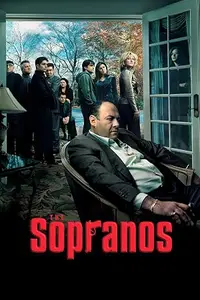
This is different from saying that nothing happens. The failed attempt transforms the men’s immediate problem and damages their claims of competence. Our reading is that the unanswered question about Valery makes their lack of control endure after the physical crisis, rather than withholding the only event the episode has to offer.
How an ordinary job becomes a test they cannot command
The collection begins inside a system in which the men expect their status and capacity for violence to settle an encounter. Their actions turn a limited task into a much larger problem. In the woods, the habits that support that status do not reliably provide direction, food or protection from the cold.
The comedy comes from the widening gap between language and practical ability. A confident account of a person or place does not give them usable knowledge of it. The same men who want to sound in command become dependent on one another and on someone else finding them.
| Stage | Claim to control | Practical limit |
|---|---|---|
| The collection | A routine job can be handled by force | Escalation creates an unwanted consequence |
| The pursuit | An injured man should be easy to account for | The trail does not produce a secure outcome |
| The night in the vehicle | One man can blame the other | Blame provides neither warmth nor direction |
| The call for help | They can still describe themselves as capable | They must depend on people outside the situation |
Why Paulie and Christopher’s argument matters
Their conflict concerns who caused the failure and who should now be obeyed. Those questions become urgent because each man’s account of himself depends partly on the other accepting it. The landscape removes familiar audiences and routines, leaving them with a relationship that is less stable than their shared affiliation suggests.
Our interpretation is that this is why the episode works beyond a survival predicament. The lack of ordinary resources makes a struggle over recognition visible. They need cooperation, but admitting dependence can feel like losing status. A joke or insult can therefore carry a practical cost when it prevents them from describing their situation honestly.
The limits of theories about the escape
A fan theory may use the missing trail, the vehicle or Valery’s demonstrated resilience to propose what happened next. Those are possibilities to compare, not interchangeable forms of confirmation. The episode does not show a completed journey back to his associates or a later confrontation that settles the matter.
Accounts of proposed or abandoned scenes belong to production history and need their own direct sources. Even if a writer describes an idea, an unfilmed or unused resolution does not automatically become an event in the released series. Keeping those categories separate lets discussion remain imaginative without presenting invention as episode recap.
Does the missing resolution improve the episode?
The strongest defence is that Valery’s disappearance denies the men a final certificate that the damage has been contained. They can leave the woods without converting the whole experience into a successful job. The unresolved possibility remains an irritant to the story they might tell about themselves.
The strongest objection is that a suspenseful pursuit appears to make a promise about outcome, and the episode declines to fulfil it. That is a fair question about narrative emphasis. It becomes more precise when connected to a particular moment that made you expect an answer, rather than an assumption that every introduced person must return for a later payoff.
A rewatch that follows competence instead of clues alone
Record every time Paulie or Christopher makes a confident practical claim, then compare what the next action establishes. Follow how food, clothing, navigation and the phone alter the balance between them. This route explains the comic structure without depending on a hidden final sighting of Valery.
For discussion, choose whether the larger loss is physical control, mutual trust or the ability to protect an image of competence. Identify one scene that supports the choice and one that complicates it. The question leaves room for different priorities while staying anchored in what the episode actually gives us.
Sources
Related coverage
Discussions
New threadDoes Pine Barrens need Valery’s fate resolved, or would that let Paulie off too easily?Spoilers
0 repliesLast postHow does an ordinary inconvenience become a test of power?Spoilers
0 repliesLast postWhat does a business conversation reveal about family language?Spoilers
0 repliesLast postWhen does loyalty become a demand to ignore evidence?Spoilers
0 repliesLast postdoes a funny scene ever make the next scene harder to watch?Spoilers
0 repliesLast post