
Carol’s ending: the final look creates a choice without guaranteeing the future
Therese’s return to the room and Carol’s response give the ending its direction. A close reading of distance, recognition and the difference between an opening and a settled life.
FilmFanatics Editorial · Published · View discussions
The ending opens a relation rather than completing its history
Therese goes to the room where Carol is, and the final exchange of looks gives that action a response. The film stops before a complete conversation about the future. Hope comes from a chosen approach and recognition, not from a detailed guarantee that every obstacle has disappeared.
Our reading is that this limit is expressive. The viewer can understand the direction of Therese's action while remaining aware of the pressures the story has established. Uncertainty does not make the ending neutral; it makes its hope specific to a decision in the present.
Sources: 1
Guide · Sources checked
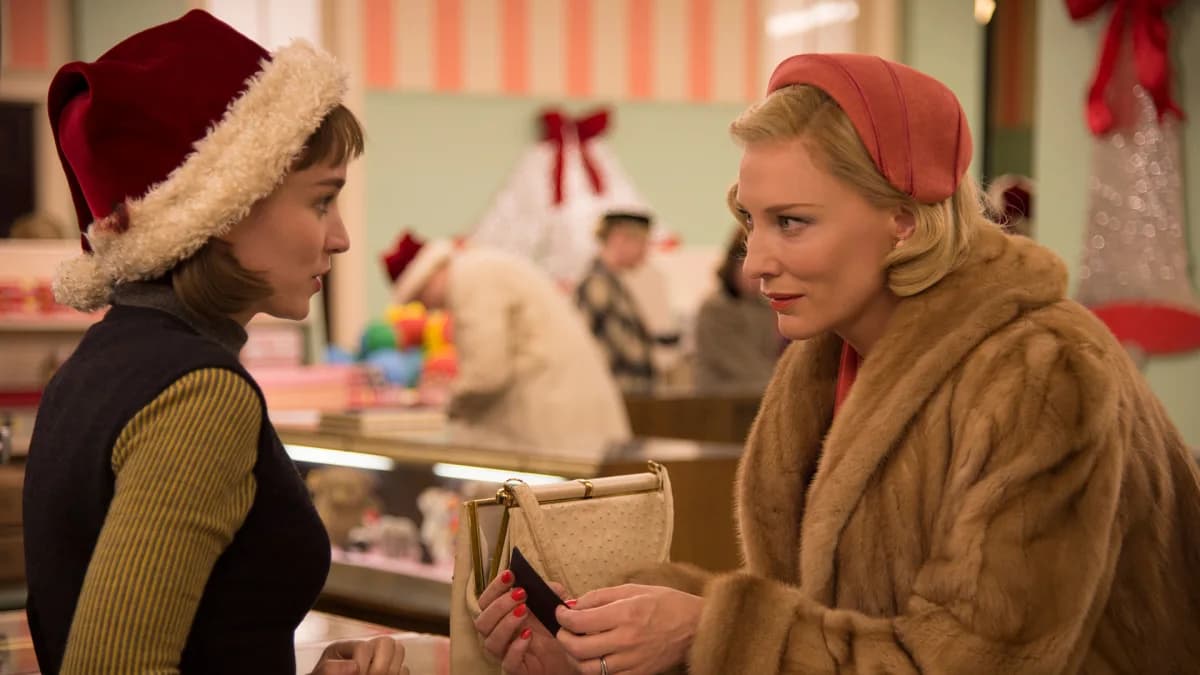
Distance turns recognition into an event
The room contains other people and ordinary activity. Therese has to identify Carol within it, and the camera lets attention concentrate across that social space. The intimacy does not require the world to vanish, even though the look changes how the space feels.
That staging matters because earlier encounters have also involved being watched, interpreted or interrupted. The final exchange gives the women a relation the surrounding activity does not fully define. It is private in effect without becoming physically outside the public world.
Therese’s movement gives her agency
The ending is not only an image of Carol waiting. Therese chooses to go, which changes the balance of an earlier invitation or separation. The action allows desire and judgment to belong to her rather than making her merely the recipient of another person's plan.
A more cautious reading can emphasize the unresolved practical future. That is supported by the absence of a full reconciliation scene. It should still account for the decision the film does show rather than treating openness as proof that nothing has changed.
A final look is not an ordinary-life epilogue
We do not see how the relationship handles every later pressure. Avoid turning the smile into a complete shared biography, whether happy or doomed. The closure concerns recognition and willingness at this moment.
For discussion, compare the last look with an earlier scene where a gesture is misunderstood or constrained. What becomes possible in the final exchange? That question preserves the ending's precision instead of demanding that it either certify everything or promise nothing.
Sources
Discussions
New threadHow much of Carol’s future does the last look actually promise?Spoilers
0 repliesLast post